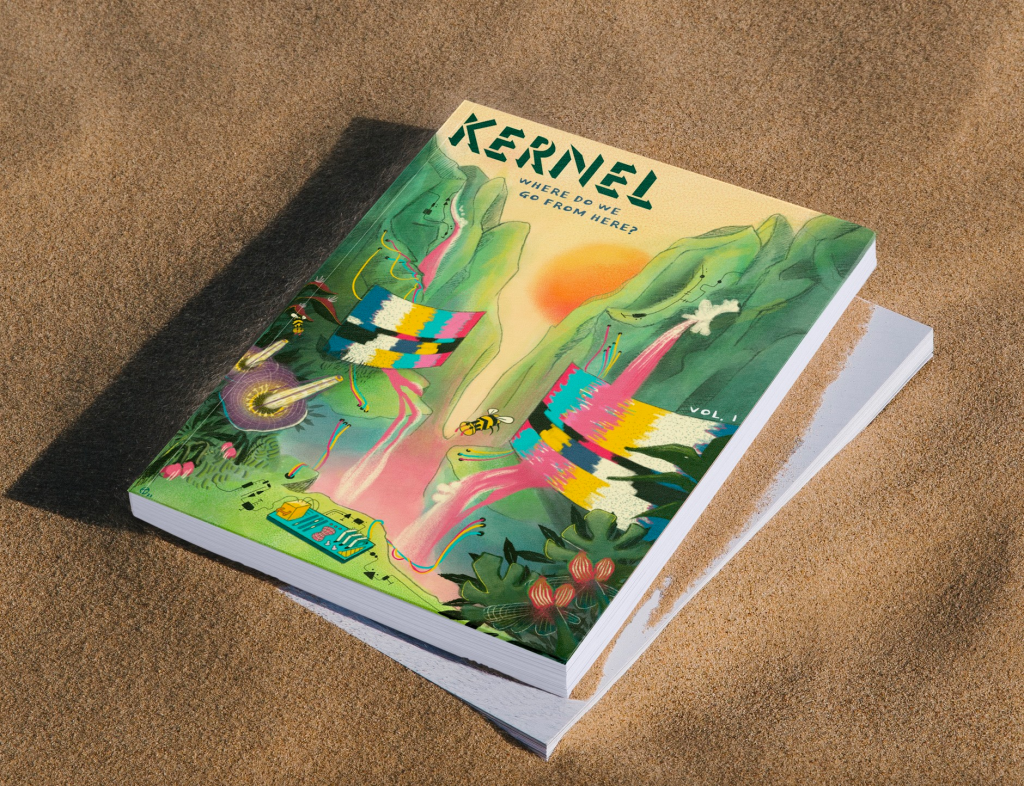
tl;dr — Reboot is an incredible community of technologists I’m so grateful to be a part of, and I am a part of the very large, care-filled effort in bringing our print publication, Kernel, to life.
This week, I hope you consider pre-ordering our magazine, which comes with a print issue, access to the digital issue, audio versions of stories, and access to subscriber-only events! https://reboothq.substack.com/subscribe
Read on for more~
I have been slowly trying to reconfigure my existence working within the technology industry, which I see intertwined with, though still different, from my existence as a technologist. This includes spending a lot of time trying to think more about the latter question so that I might navigate to a more personally authentic answer to the former. That said, we have all been pushed further in negotiating our experiences as technologists, with the still-compulsory cautious distance of this on-going pandemic (I jotted some thoughts about distance and pixellation, here).
I knew, intellectually, of the ways scale falls flat, via Anna Lowenhaupt Tsing’s “A Theory of Nonscalability,” and yet, I clung to the belief that the only way I might get to matter in the world was solely through working on things that had Big Numbers attached to them. In a Twitter DM conversation, this revelation emerged: some old thoughts I had about wanting to make a “dent in the universe” were also “an articulation of my desire to matter in the world…I just remember feeling very lonely and discouraged back then / and I think the way I coped with that was overcompensating with dreams of grandeur / like ‘the only way I could possibly matter is by doing something world-changing on a societal scale.’”
In my time living in San Francisco, I’ve been marveling at all the ways people work towards the futures they hope to see for themselves and their communities beyond that of building software, like through telling stories of science and speculative fiction, organizing in the face of oppressive socio-political systems. Similarly, I wonder about whose futures are manifested, which is to ask, who has the time, energy, money, *power* to bring their dreams to life? Who has to surmount additional odds just to stay afloat, survive in the present, let alone work toward their potential futures?
~~~
Through Feb 2020-Feb 2021 of pandemic, I’d been so incredibly blessed to have lived with two dozen-ish artists in San Francisco, and what I remain moved by is the generosity of time and energy I experienced; I still marvel at the ways we came together to find reasons to celebrate each day, and each other, through shared meals and dance parties alike. Then, from April – May 2021, I had the chance to live with 11 other young technologists in Asheville, North Carolina, working on pieces that included historical analyses, personal essays, and speculative fiction about histories, present experiences, and collective futures of and shaped by technology.
My time living within both of these communities, one oriented amid artists (who often also were technologists), and another amid technologists (who often also were artists), reaffirmed my own hopes for my existence in the world, rewired the way I felt I could exist in the world. It gave me an embodied, visceral permission to find hope and meaning in the grassroots, in little acts of big care. I don’t have to be an omniscient, omnipresent god, via projects of mass scale, to matter in the world. I can just be here; the project of sustaining life is so tender, tenuous, and tough in itself.
~~~
In so many conversations with friends, queer/trans, femme, BIPOC, we’ve talked about we’ve been primed throughout our lives to feel like we have to struggle through discomfort, that we ought to fight through spaces and relationships that aren’t crafted with us in mind. For me, I recognize this compulsion toward pushing through, toward people-pleasing, as a fear of whatever it is that follows losing institutional approval. But what if we could expect more, and work toward something better?
~~~

looping “20-something,” thinking about how defeated and triumphant the song sounds depending on when you’re listening: “hoping my 20somethings won’t end / hoping to keep the rest of my friends / hoping my 20somethings don’t kill me, kill me”
Stumbling through my 20-something-existence trying to piece together feels about diaspora, queerness, has led me to marvel at the ways we find unexpected kin swimming through algorithmic currents, the ways we uncover histories so that we may learn more about who we are, the cyborgness of embodying our inherited multiplicities and contradictions to become something new altogether.
In this line of personal inquiry, I’ve come to reckon with the ways history contains the knowledge of our forebears, and informs how:
- we arrived at our present moment
- we might work toward our dreams for what’s to come
- we might work toward emergent dreams might not yet imagine today.
~~~

Kernel is a print publication that grapples with the past, present, and future of technology. It is a largely volunteer effort, with current funding going toward compensating magazine authors and artists, and features historical analyses, personal essays, speculative fictions, and so much more.
Witnessing Kernel come to life through the love, care, energy, time of so, so, so many Reboot community members has been such a gift — to be with this geographically-dispersed, remote-first community of passionate, fiery young technologists is all I could have wished I had when I started college, an undergrad studying computer science, moonlighting as a reporter for a daily print newspaper on campus, trying to place myself as a baby adult in the world, just beginning to step foot into an industry that has exerted and will continue to exert unprecedented impact on the world.
With Kernel, we want to address the gap that exists between: the blanket rejection of technology in science, technology, and society studies, and the uncritical optimism of hype cycles and techno-utopianism alike.
You can read more about the progressive take for a more critical techno-optimism, written by Reboot director and co-founder, Jasmine Sun, here: https://reboothq.substack.com/p/manifesto
“In computer science, the kernel is the most fundamental part of a computer’s operating system. It is responsible most notably for memory, as well as CPU time, used for executing instructions.
In ecology, kernels are the inner parts of seeds, and are often edible, even nourishing. In speech, the kernel of an argument is the core important idea of a subject.
We’re interested in the tensions between these definitions: human-made kernels govern systems in a top-down fashion, which is at odds with the bottom-up ecological world-building borne from natural kernels.
We’re also interested in the similarities: in all these systems the kernel is fundamental, and its composition and potentialities are thus worth understanding.”
Jasmine Wang, Kernel editor-in-chief, on the process and philosophy behind the magazine: https://reboothq.substack.com/p/kernel-launch
We are offering pre-orders to Kernel for $30 until October 8. Our launch offer gives you access to the print and digital versions of our magazine, invites to private monthly events and seminars, and audio/video recordings of events and essays.
If you know me from my journalism and student media days, you know how difficult and fraught it is for media organizations, across geographies and scales, to achieve sustainable financial independence in the age of algorithmic newsfeeds, content farms, opportunistic businessmen, and platform monopolies (peep this op-ed I penned about voting ‘yes’ on a referendum to fund our newsroom in 2018).
It feels like we have at hand a new iteration of the tragedy of commons — often brought up in relation to voter turnout — what might happen if we were to come together to support the communally-run projects and initiatives we hope to see on the internet, and in the physical world? What might a better internet, one where we can convene for more vibrant and authentic communities look like?
I’m heartened thinking about the wellspring of collective wisdom that could emerge with more grassroots media efforts, and hope you’ll consider supporting this one today 
You can preorder Kernel here!: https://reboothq.substack.com/subscribe

 J. YURU ZHŌU
Leave a comment